Enlarged Prostate vs Prostate Cancer: Key Differences, Symptoms, Tests and Treatment

Enlarged Prostate vs Prostate Cancer: Key Differences, Symptoms, Tests and Treatment
Waking up three or four times at night to urinate? Noticing a weaker urine stream than before? Your first concern might be whether these changes indicate prostate cancer. The good news is that urinary problems often result from a non-cancerous enlarged prostate. Still, you should not ignore persistent symptoms. Understanding the difference between an enlarged prostate and prostate cancer can help you recognise warning signs, choose appropriate tests, and seek treatment without unnecessary fear.
At Dr Das Multispeciality Hospital, patients concerned about prostate health can benefit from understanding how these conditions differ and why an accurate diagnosis matters.
1. Enlarged Prostate vs Prostate Cancer: What Is the Difference?
An enlarged prostate, also called benign prostatic hyperplasia (BPH), is a non-cancerous increase in prostate tissue. Prostate cancer develops when abnormal cells grow uncontrollably and may spread beyond the gland.
Both conditions become more common with age, but they require different approaches to diagnosis and treatment.
A Urologist in Mumbai can assess urinary symptoms, review PSA results, and recommend investigations based on your individual risk.

Quick Comparison: Enlarged Prostate vs Prostate Cancer
| Key Factor | Enlarged Prostate (BPH) | Prostate Cancer |
|---|---|---|
| Nature | Non-cancerous enlargement | Malignant tumour |
| Cancer risk | BPH does not turn into cancer | Cancer may spread |
| Early symptoms | Often causes urinary changes | Usually no symptoms |
| Main impact | Urinary flow and bladder emptying | Depends on cancer stage |
| Common assessment | IPSS, DRE, uroflowmetry, ultrasound | PSA, DRE, MRI, biopsy when indicated |
| Progression | May worsen urinary obstruction | May remain slow-growing or progress |
| Treatment | Medication, procedures, surgery | Surveillance, surgery, radiation, systemic therapy |
| Outlook | Usually manageable | Depends on stage and cancer grade |
An important point from modern Urology practice is that having BPH does not itself increase your risk of prostate cancer. Both conditions can exist at the same time.
2. Enlarged Prostate (BPH): Why Does It Affect Urination?
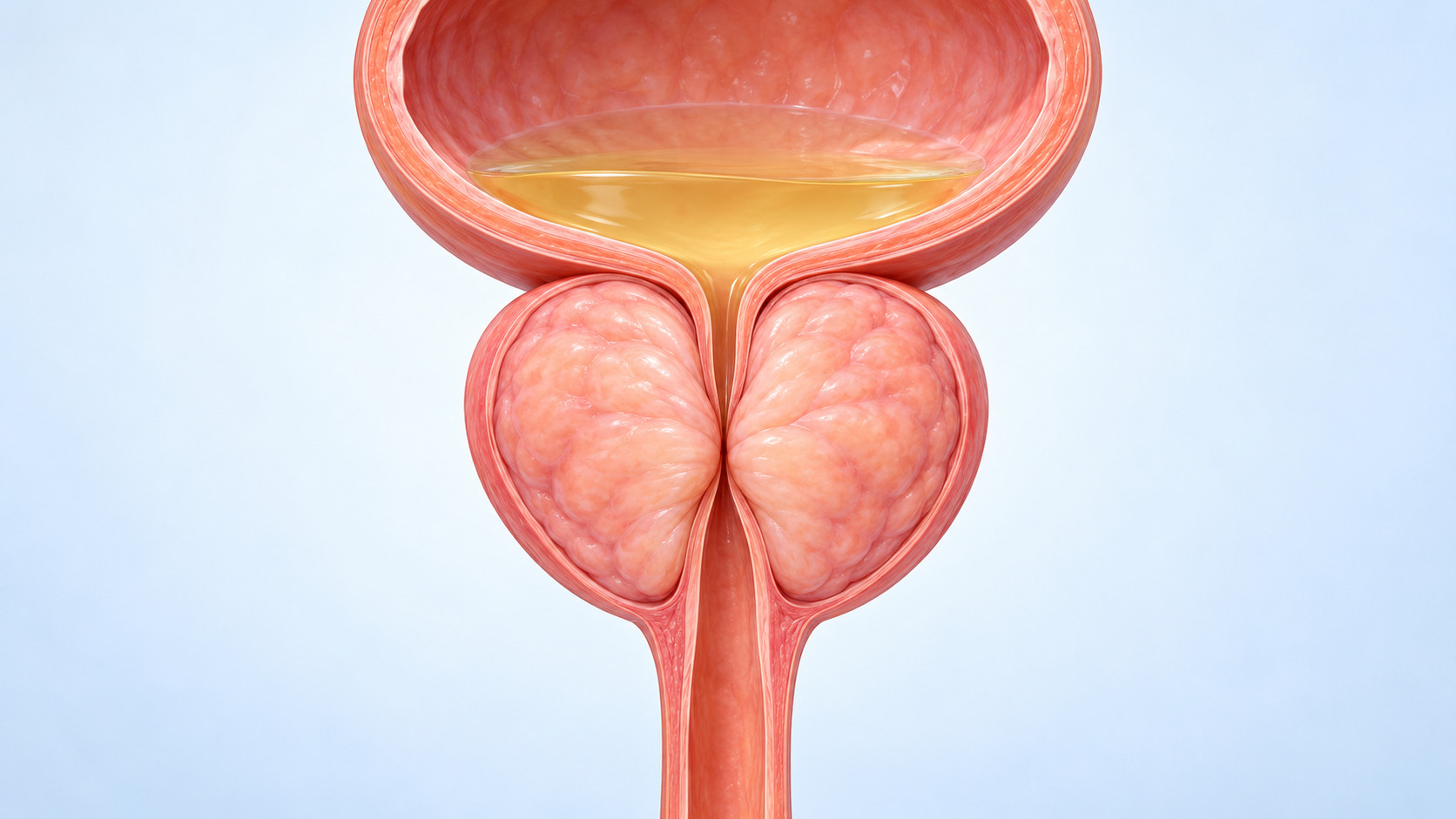
The prostate sits below the bladder and surrounds the urethra, which carries urine out of your body.
With age, tissue in the prostate's transition zone may grow and compress the urethra. This makes it harder for urine to pass.
Symptoms You May Notice
- Weak or interrupted urine stream
- Difficulty starting urination
- Straining while passing urine
- Frequent urination, particularly at night
- Sudden urgency to urinate
- Post-micturition dribbling, or leakage after urination
- Feeling that your bladder remains partly full
Does a Bigger Prostate Mean Worse Symptoms?
Not necessarily.
Ultrasound measures prostate volume in cubic centimetres (cc). A man with a 60 cc prostate may experience mild symptoms, while someone with a 35 cc prostate may struggle with urinary flow.
The degree of obstruction, bladder function, and prostate anatomy often matter more than size alone.
3. Prostate Cancer: Why Early Detection Matters
Unlike BPH, prostate cancer often develops in the peripheral zone of the prostate.
Early prostate cancer usually causes no noticeable symptoms. You may have normal urination even when cancer is present.
This is why relying only on symptoms can delay diagnosis.

Symptoms That Need Medical Evaluation
- Blood in urine or semen
- Persistent urinary difficulties
- Unexplained pelvic discomfort
- Ongoing back or hip pain
- Unexplained weight loss in some advanced cases
These symptoms have several possible causes and do not confirm prostate cancer.
Modern assessment may identify suspicious changes through PSA testing and multiparametric MRI (mpMRI), followed by biopsy when appropriate.
Who Should Consider Earlier Prostate Cancer Screening?
Risk increases with age and family history.
Men with a strong family history of prostate cancer or known inherited mutations, particularly BRCA2, may benefit from discussing PSA screening around age 40–45.
BRCA1 and Lynch syndrome-related mutations may also influence risk assessment.
For average-risk men, screening discussions commonly begin around age 50, although recommendations differ.
Screening should involve shared decision-making because PSA testing can lead to unnecessary investigations and treatment of cancers that might never cause harm.
4. How Doctors Distinguish BPH From Prostate Cancer
A structured evaluation helps identify whether urinary symptoms result from prostate enlargement, cancer, infection, or another condition.

Step 1: IPSS Questionnaire
The International Prostate Symptom Score measures urinary symptom severity.
It assesses frequency, urgency, weak stream, straining, night-time urination, and other concerns.
Step 2: DRE and Uroflowmetry
A digital rectal examination (DRE) helps assess prostate texture and detect certain abnormalities.
Uroflowmetry measures urine flow rate, including maximum flow (Qmax).
Reduced flow may suggest obstruction but does not establish its cause.
Step 3: PSA Blood Testing
PSA testing helps assess prostate cancer risk.
Doctors may consider total PSA, free-to-total PSA ratio, prostate volume, and changes in PSA over time.
PSA velocity alone should not determine whether you need a biopsy.
An elevated PSA can also occur with BPH, inflammation, or infection.
Step 4: Multiparametric MRI
When cancer is suspected, mpMRI helps identify suspicious prostate areas.
Hospitals with appropriate imaging infrastructure may use 1.5T or 3T MRI scanners for prostate assessment.
MRI findings help determine whether a biopsy is needed.
Step 5: Targeted Prostate Biopsy
MRI-targeted biopsy, sometimes using MRI-ultrasound fusion, helps sample suspicious areas.
Doctors may combine targeted and systematic samples. The transperineal approach can reduce infection risk compared with transrectal biopsy.
A biopsy confirms the diagnosis and helps determine cancer grade.
5. Modern Treatment Options: BPH vs Prostate Cancer
Treatment depends on symptoms, test findings, age, general health, and personal preferences.

Treatment for Enlarged Prostate
For mild BPH, lifestyle changes and monitoring may be sufficient.
Medication options include:
- Tamsulosin to relax prostate and bladder-neck muscles
- Finasteride to gradually reduce prostate size in suitable patients
When medication does not provide adequate relief, procedures may include:
- TURP to remove obstructing prostate tissue
- HoLEP or thulium laser enucleation
- Rezūm water-vapour therapy
- UroLift implants for selected patients
Some minimally invasive treatments offer better preservation of ejaculation than conventional surgery. Results depend on the procedure and individual anatomy.
Treatment for Prostate Cancer
Treatment is guided by cancer risk and stage.
| Cancer Category | Possible Management |
|---|---|
| Low-risk, localised | Active surveillance |
| Intermediate-risk, localised | Surgery or radiation therapy |
| High-risk, localised | Surgery in selected patients or radiation combined with hormonal therapy |
| Advanced or metastatic | Hormonal therapy and other systemic treatments |
Robot-assisted radical prostatectomy (RARP) is one surgical option for suitable patients with localised prostate cancer.
The surgeon controls robotic instruments to remove the prostate. The system does not operate independently.
Robotic surgery may offer recovery benefits in selected cases, but urinary and sexual side effects remain possible.
6. When Should You Seek a Prostate Evaluation?
Not every urinary change indicates a serious disease, but certain symptoms deserve attention.
Book a urological assessment if you notice persistent weak urine flow, repeated night-time urination, difficulty emptying your bladder, or an elevated PSA result.
Seek urgent medical care if you cannot pass urine, develop fever with urinary symptoms, or experience heavy bleeding with clots.
Early evaluation can identify treatable urinary problems and help detect prostate cancer when clinically indicated.

Frequently Asked Questions
Take the Next Step Towards Better Prostate Health
An enlarged prostate and prostate cancer can affect the same gland, but their diagnosis, treatment, and long-term outlook differ. A weak urine stream does not automatically mean cancer, and the absence of urinary symptoms does not rule it out.
If you are experiencing frequent urination, difficulty passing urine, or concerns about rising PSA levels, consider scheduling a prostate health consultation at Dr Das Multispeciality Hospital. A qualified urologist can determine whether you need an IPSS assessment, DRE, uroflowmetry, PSA testing, or further imaging such as multiparametric MRI.
The right evaluation can help you move from uncertainty to a clear, personalised care plan.